
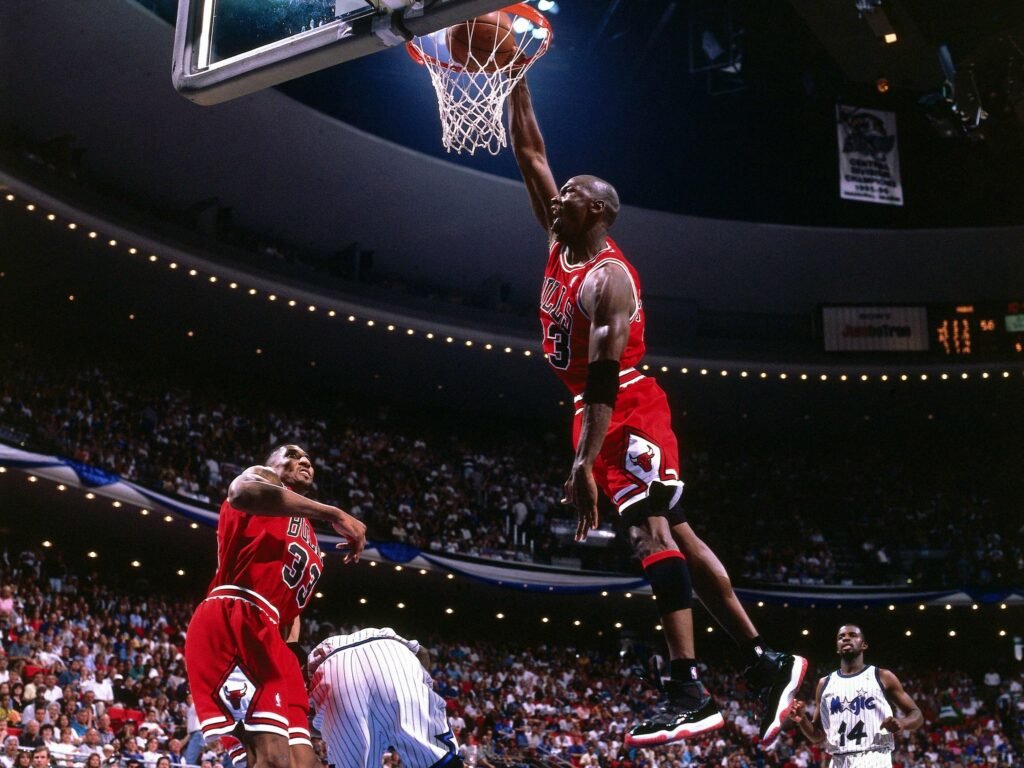
Introduction to Michael Jordan
Michael Jordan, widely regarded as one of the greatest basketball players of all time, was born on February 17, 1963, in Brooklyn, New York. He later moved to Wilmington, North Carolina, where he grew up in a close-knit family. Jordan’s passion for sports was evident from an early age; however, it was basketball that captured his heart. Encouraged by his father, he began to play competitively, honing his skills on local courts and quickly gaining recognition for his exceptional athleticism and determination.
During his high school years at Emsley A. Laney High School, Jordan faced several challenges, particularly in his sophomore year when he was cut from the varsity basketball team. This setback fueled his ambition to improve, and he spent countless hours training, showcasing his resilience and commitment to the sport. By his junior year, he had made the varsity team and emerged as a standout player, averaging an impressive 20 points per game. His performance attracted the attention of college scouts, ultimately leading him to the University of North Carolina.
At UNC, Jordan played under the legendary coach Dean Smith, where he refined his skills further and demonstrated his potential on a national stage. His defining moment came in 1982 when he hit the game-winning shot in the NCAA championship game against Georgetown, securing the Tar Heels’ victory. This pivotal achievement not only solidified his reputation as a clutch player but also set the stage for his entry into the NBA.
In 1984, Michael Jordan was selected as the third overall pick in the NBA Draft by the Chicago Bulls. Despite facing the pressures of professional basketball, his early experiences at UNC equipped him with the mental toughness and competitive spirit needed to thrive in the league. This formative journey paved the way for his legendary status, leading to a career filled with unparalleled achievements and a lasting impact on the world of basketball.
Michael Jordan’s Impact on the NBA
Michael Jordan’s contributions to the National Basketball Association (NBA) are monumental, establishing him as not only a legendary player but also a cultural icon. His revolutionary playing style, characterized by unmatched athleticism, precision, and flair, redefined what it meant to be a basketball superstar in the 1980s and 1990s. Jordan’s competitive spirit was unparalleled; he possessed a relentless drive to win that inspired his teammates and instilled fear in his opponents. This tenacity culminated in six NBA championships with the Chicago Bulls, solidifying his legacy as a champion.
During his illustrious career, Jordan set numerous records that still resonate within the league. He was a five-time Most Valuable Player (MVP) and holds a remarkable average of 30.1 points per game, the highest in NBA history. His influence extended beyond his on-court feats; Jordan’s charisma and work ethic made him an enduring figure in basketball culture. He was instrumental in popularizing the NBA globally, turning it into a household name during the 1990s. The iconic “Air Jordan” sneaker line exemplifies this, marking a monumental shift in sports marketing and branding.
Jordan’s impact on the NBA is evident in the modern player’s approach to marketability and brand development. Athletes today, inspired by his success, often emulate his strategies in building personal brands, which has led to a new era in sports commerce. Furthermore, his role in bringing basketball to a global audience has increased the NBA’s fan base exponentially, broadening the sport’s appeal beyond American borders. Michael Jordan’s legacy is imprinted not just in records and accolades, but in the evolution of professional basketball itself, underscoring his status as an NBA basketball god.
Iconic Moments: A Journey Through His Career
Michael Jordan’s illustrious career in the NBA is marked by a series of iconic moments that not only defined his legacy but also transformed the fabric of basketball itself. One of the most memorable instances occurred during the 1997 NBA Finals, when Jordan delivered a breathtaking performance in Game 5, famously known as “The Flu Game.” Despite battling illness, he scored 38 points, guiding the Chicago Bulls to a critical victory over the Utah Jazz. This moment exemplified his unparalleled determination and ability to perform under extreme pressure, further solidifying his status as a basketball deity.
Another significant highlight came in the 1989 playoffs, when Jordan hit a last-second jumper over Craig Ehlo of the Cleveland Cavaliers in what is now referred to as “The Shot.” This game-winning basket not only clinched the series for the Bulls but also epitomized his clutch gene. Jordan’s ability to deliver in critical moments established him as a go-to figure, creating a legacy that resonated throughout the NBA.
Jordan’s storied rivalries, particularly with players such as Larry Bird and Magic Johnson, further added to the lore surrounding his career. The fierce competition against these legends during the late 1980s and early 1990s showcased not just individual talent but elevated the game itself. The memorable battles in the NBA Finals against the Detroit Pistons in the late 1980s, famously dubbed the “Bad Boys,” highlighted Jordan’s resilience as he finally overcame the physical play of the Pistons, setting the stage for his eventual championships.
Each of these pivotal moments not only speaks to Jordan’s extraordinary basketball skills but also to his indomitable spirit, contributing to the enduring mythos surrounding him. As a symbol of excellence in sports, Michael Jordan’s contributions to the NBA go beyond statistics; they represent an era defined by memorable rivalries and exceptional performances that shaped the game and continue to inspire generations of athletes.
The Enduring Legacy of Michael Jordan
The legacy of Michael Jordan transcends the basketball court, resonating significantly through the realms of sports and culture. His influence extends beyond his six NBA championships and numerous awards; it encompasses the very essence of competitive spirit and determination that modern athletes aspire to embody. Young players entering the NBA today frequently cite Jordan as a primary influence, emulating his work ethic, competitive nature, and ability to perform under pressure.
Jordan’s impact is not merely confined to individual achievements; he played a pivotal role in popularizing the NBA globally during the 1990s. His charisma and unmatched prowess on the court attracted millions of fans, bridging gaps across cultures and geography. Consequently, Jordan has influenced not just aspiring basketball players but also casual sports enthusiasts, enhancing the overall popularity of basketball around the world.
Moreover, Jordan’s philanthropic activities further cement his status as a role model. He has contributed to numerous charitable causes, focusing on areas such as education, health, and poverty alleviation. His commitment to giving back to the community exemplifies the responsibility athletes have towards society, encouraging others in the sports world to engage in philanthropy. Additionally, as the owner of the Charlotte Hornets, Jordan continues to make significant contributions to the basketball ecosystem, directly influencing policy and strategy at a high level.
Today, Jordan remains a prominent figure within the basketball community. He is synonymous with excellence and represents an unyielding pursuit of greatness. His essence continues to inspire future generations of players to push boundaries, propel the sport of basketball forward, and strive for the peak of athletic success. Ultimately, Michael Jordan is not just a retired athlete; he embodies the spirit and culture of basketball itself, enduring as an icon of hard work, success, and integrity in sports.